Work · Talk · DevLearn 2025
Bump the Lamp.
A DevLearn 2025 session on what film and TV can teach us about learning design.
- EventDevLearn 2025, session 113
- WhereLas Vegas
- FormatConference talk
What it is
Films are built to hold attention. They plant details that pay off later, give characters something to chase, start in the middle of the action and polish things nobody notices. The talk takes those techniques and applies them to learning design.
It runs in three acts, like a film. Each technique comes with a film example and the parallel in learning design, so there's something to try in your next project.
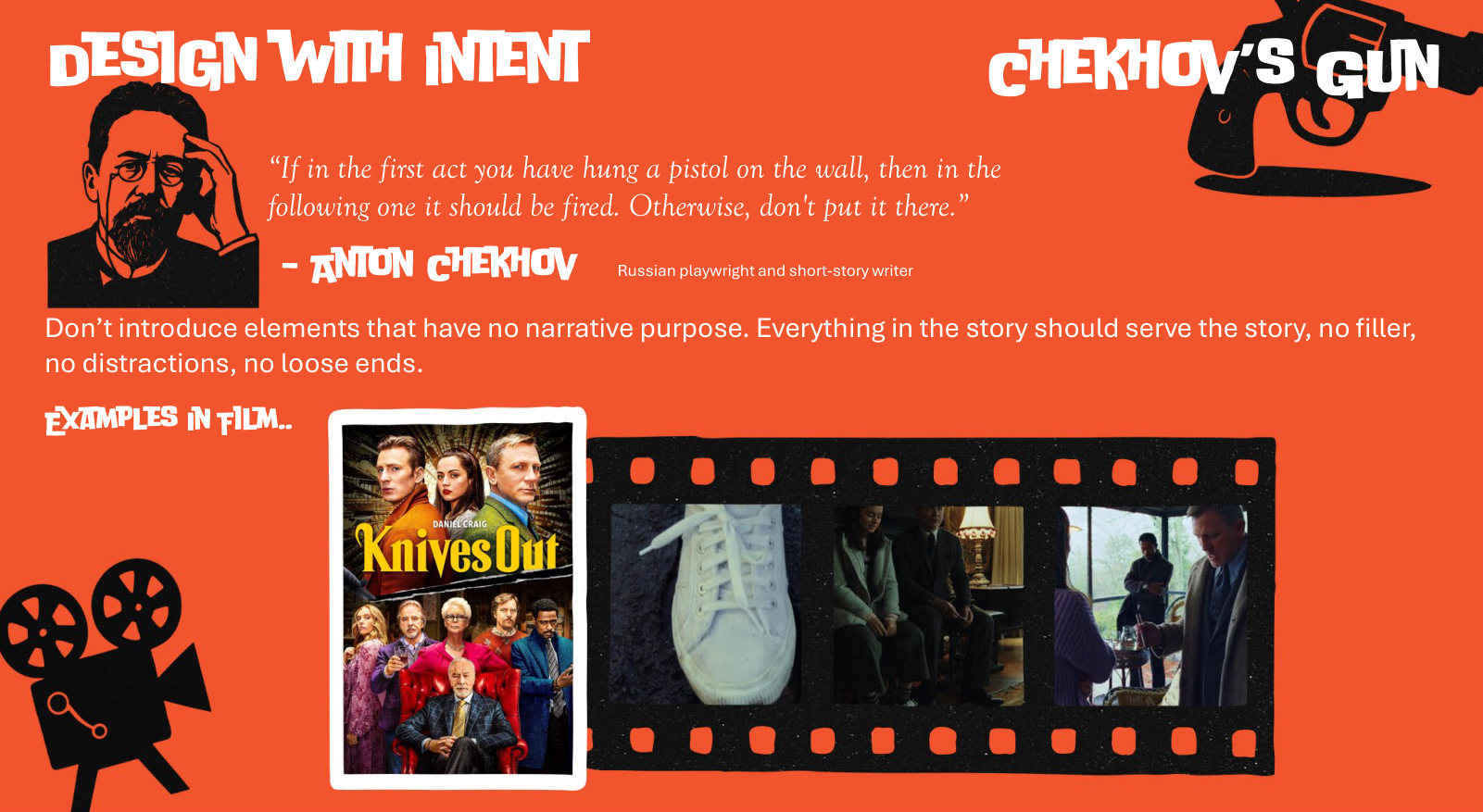
Poster and stills from Knives Out (2019), written and directed by Rian Johnson, distributed by Lionsgate. Shown for criticism and review.
Why it matters for learning design
A lot of courses fall flat for the same reasons a bad film does. Details are set up and never pay off. The learner has no reason to care. Topics are joined by "and then". The rough edges make the content harder to trust. Film has spent a century solving these problems, and learning design can borrow the answers.
The shift is to see the designer as a director. Every element on screen should earn its place, and the learner should act and find things out instead of being told. That's when people stop just completing a course and start experiencing it.
The three acts
Act I: Pre-production
Planning and purpose, before a single screen is built. Chekhov's gun: only include what pays off later. The MacGuffin: give learners a mission, like an audit deadline or a client about to walk, so every topic has a reason to be there. Start in the action: open with a problem or a decision, not a welcome and a list of objectives. But and therefore: link each step to the last by consequence or complication, not "and then".
Act II: Production
Crafting the experience. Show, don't tell: put the learner in the scene and ask what they'd do, instead of listing the rules. The red herring: build wrong answers from real mistakes, so they tempt instead of being easy to dismiss. Framing and composition: use the rule of thirds, leading lines, negative space and colour to guide the eye. Sound: use cues, ambience and silence to shape attention and feeling.
Act III: Post-production
Polish and trust. The test screening: we know the content too well to see its blind spots, so pilot with three to five learners before release. Bump the lamp: sweat the small details learners will never mention but will always feel.
Why "bump the lamp"
In Who Framed Roger Rabbit, a character knocks an overhead lamp and it swings. The animators could have cut it. Instead they hand-drew every moving shadow and reflection so the cartoon sat properly in the real room. Most viewers never noticed, but they felt the scene was real.
Learners won't praise the kerning or the hover state on a button. They will feel it when fonts don't match, spacing is uneven or the audio glitches, and they trust the content less. Polish is how a course earns trust.